

American Alligator


OVERVIEW


American Alligators (Alligator mississippiensis) are an important part of the ecosystem of Bald Head Island and are considered by many to be a "keystone" species. A keystone species is one that is essential to the integrity and stability of a particular ecosystem.


These ancient reptiles are native to coastal southeastern North Carolina, and it is our responsibility to learn how to live in accord with them. By observing from afar, and by not habituating these animals to humans, we can safely keep alligators as an interesting and important part of Bald Head Island’s unique environment. As development continues on Bald Head Island, we will continue to displace many plants and animals that lived here long before people arrived. If we wish to continue to live in harmony with nature, we must learn to co-exist with these organisms. The mere presence of an alligator does not mean it is a nuisance animal. If left alone, an alligator basking by the water’s edge will simply move on when it has soaked up enough sun.


Alligators are the largest reptiles in North America, and they are usually harmless if left alone. It is extremely important for all our visitors to understand that alligators should NEVER be fed, and there is a Village ordinance that prohibits this on Bald Head! Alligators lose their natural fear of humans when fed, and become accustomed or attracted to people. Alligators that have been fed may be more likely to attack, and are more likely to become nuisance animals that must be destroyed. Feeding gators presents a danger not only to the feeder, but also to those who innocently follow behind. Hopefully, the information here will help you better understand these amazing reptiles, so that you may respect and enjoy their presence on Bald Head Island.


*Because of their small size, children and pets more closely resemble the natural food of alligators and are more susceptible to attacks. For this reason, please do not allow your children or pets near any freshwater pond or lagoon.*


Physical Features


Behavior


Because they are cold blooded, during the winter months alligators move to dens or deep holes, where they undergo periods of dormancy. Low guttural bellowing, head or tail slapping, and complex body postures are behaviors commonly used by alligators as warnings or as their claim to territory. Always be alert when walking near alligator habitat, and be aware of signs of aggression when encountering an alligator. If an alligator moves toward you or displays any of the gestures listed above, respect the great creature and move away!


Habitat


Alligators are found in the U.S. as far north as North Carolina, and west to Texas. They live in freshwater swamps, marshes, ponds, lakes, and occasionally can be seen traveling through brackish water. Although alligators have been observed in the brackish tidal creeks around Bald Head Island, and have been known to even take a quick dip in the salty ocean water, sightings in such tidal areas are rare. Unlike their cousin, the American crocodile, American alligators cannot tolerate saltwater for extended periods. Biologists think these occasional forays into saltwater may help rid the alligators of parasites. Fresh water is a necessity for alligators, and during a drought they will travel great distances to find water holes. Alligators most often will bask in the sun or float at the surface of the water; they can remain underwater for 45-60 minutes. While they will typically remain in the water or along the water’s edge, alligators are capable of short bursts of speed on land – up to 30 mph!


On Bald Head, alligators inhabit the system of golf course lagoons and other freshwater ponds on the island. Perhaps the best place to see an alligator is the Conservancy’s Wildlife Overlook, a lagoon located off of Stede Bonnet Wynd, just north of Bay Tree Trail. When in the vicinity of these freshwater habitats, even though you may not see alligators, you should be aware of their possible presence.


Mating


Alligators are sexually mature when they reach five to six feet long. It may take 10-15 years for gators to reach these lengths. The onset of the breeding season is directly related to air temperature, so while gators in Florida may begin courtship in mid-April, it is likely to be May or June before beginning in North Carolina and will last 6-8 weeks. After mating, the female builds a mound nest composed of vegetation, lined with mud and sticks. A female lays anywhere from 30-70 eggs in the nest, and then covers them with more plant material, which creates heat as it decomposes. This keeps the eggs moist and warm during the 65-day incubation period. The temperature inside the nest during the first 3 weeks of incubation will determine the sex of the babies. Eggs at temperatures greater than 91°F develop into males; eggs at less than 85°F develop into females and eggs in between these temperatures develop into either males or females. A female alligator has very strong maternal instincts, which can cause her to become aggressive if she thinks the nest or young are threatened. Any areas where alligators are nesting or where baby alligators are found should be cautiously avoided.


Food


Alligators eat a variety of things, including insects, fish, turtles, frogs, snakes, birds, raccoons, deer and even other alligators. Adult gators will eat 20 pounds of food a week during the hot summer, but consume nothing in the winter. With the most acidic digestive system of any vertebrate, alligators are even capable of digesting bones and feathers. The alligator is an excellent hunter, stalking its prey slowly, and making a quick catch with its strong jaws. Small prey may be swallowed hole, while larger prey will be vigorously shaken to rip off swallowing-size pieces. A very large prey animal, such as a deer, will typically be rolled underwater and drowned, then guarded for a few days until the meat is rotten enough to be ripped apart.


Legal Status


Alligators are protected on the state and federal level; therefore feeding, trapping, or injuring alligators is strictly against the law. Because it is a very serious concern,
the Village of Bald Head Island has an ordinance prohibiting the feeding or
harassing of alligators. Violations of this ordinance may result in a fine of up $500.


Please DO NOT attempt to touch, taunt, or feed alligators. An alligator that has been fed by people loses its natural fear of humans, and is more likely to approach people for food. By feeding alligators, you are not only breaking the law and endangering yourself, you are putting those who follow at risk!


Residents and visitors must use good judgment to help prevent unwanted interactions with alligators. Unattended pets, children, or even careless behavior by adults around alligators and their habitats can lead to unfortunate incidents. Removal of captured alligators is not a permanent solution to the problem, since relocated alligators usually return to their home site. By being aware of these animals and their freshwater habitats, we can all help ensure that alligators and people can safely coexist on Bald Head.

Safety

Please keep in mind these important safety tips when visiting Bald Head Island:


1. Do NOT feed alligators, turtles or any other wildlife; call the Conservancy or Police if you see someone feeding the alligators

2. Do not allow your children or pets near the edge or in any of the freshwater ponds

3. Do not fish in any of the freshwater lagoons

4. Observe alligators from a safe distance; never get closer than 20 feet to an alligator; if it hisses or opens its mouth in defense, back away even further

5. Do not harass, taunt or throw objects at alligators; call the Conservancy or Police if you see this happening

6. If you suspect an alligator of behaving aggressively, move away from the area and contact the Bald Head Island Police (457-5252) and the Bald Head Island Conservancy (457-0089)

7. It is normal behavior for an alligator to bellow (a low guttural growl) during mating season; on BHI, this can occur anytime between April and July

8. If you see an alligator wandering on land with no water nearby, please contact the Bald Head Island Police (457-5252) and the Bald Head Island Conservancy (457-0089)


RESEARCH


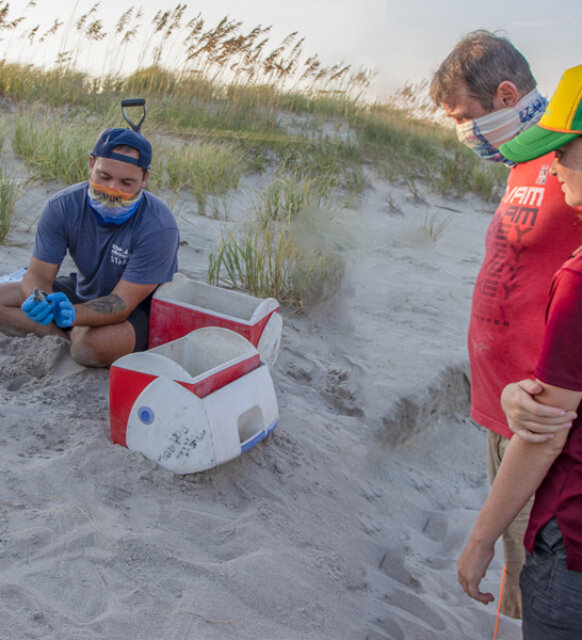
Since 2004, the Conservancy has been using summer interns to help study the population of alligators on Bald Head Island. Using a spotlight survey method, interns patrol all of the golf course lagoons looking for their red eye shine. Once an alligator is observed, the interns note the location and approximate length of the animal. We typically are only able to see the alligator’s head at the surface of the water, so we must determine the length by approximating the distance between the tip of the snout and the eyes. This length in inches will give the approximate length of the gator in feet. We are just beginning to learn about our alligator population and there are many questions that remain.


WHAT ARE WE HOPING TO LEARN?


RESULTS: 2006


Average size = 4.34’

Maximum = 9.5’ Minimum = ~1.5’


Photo by Shawn Van Slooten
Tracks in sand
Photo by Donna Finley